Automotive Market Research Company: Real Drivers in 60+ Countries

Automotive market research puts real drivers in front of your car, your screen, your showroom or your service plan, in 60+ countries. Car clinics, in-car usability tests, buyer interviews, dealership visits and ownership diaries, with one team from brief to debrief.
Automotive market research puts real drivers in front of your car, your screen, your showroom or your service plan, and records what they do, say and decide. The methods range from car clinics and in-car usability tests to buyer interviews, dealership visits and ownership diaries. The result is a decision an engineer, a product manager and a marketing director can act on together.
Picture a driver in Munich pairing her phone with a pre-production infotainment system for the first time, with a moderator in the passenger seat and the launch date fixed. What she does in the next ninety seconds is what the HMI team has waited eighteen months to see.
MindMarket is an automotive market research company working across 60+ countries · 400+ projects delivered · 50+ global clients. We recruit real drivers and real buyers of the segment, screen them on the car they own and the one they intend to buy, and put them in front of what you are building, in the countries where you sell it, through one point of contact.
Rather talk first? Book a call.
Key takeaways
Automotive research works when the drivers are real: owners and intenders of the segment, screened on their car and their budget, never a standing panel.
Six questions cover most automotive briefs: the screen, the model, the buyer, the dealership, the subscription and the first thirty days of ownership.
Numbers and stories belong together. A task-completion rate tells you a menu fails; the driver's words tell you why, and what to change.
One method per question, one team across markets. A clinic in Munich and a clinic in Madrid only compare if the same team wrote both briefs.
Automotive research runs on a product calendar. Design freezes, launches and model years set the dates; the study has to fit them.
What is automotive market research?
Automotive market research is the study of how people choose, buy, use and talk about vehicles and the services around them, run for carmakers, suppliers, dealer groups and mobility brands. The qualitative side, which is what MindMarket runs, works with small groups of real drivers in depth: what they notice in a showroom, where a screen loses them, why a lease beat a purchase.
The field has its own vocabulary. A car clinic puts a prototype or a facelift in front of intenders, often next to unbadged competitors. A usability test gives drivers tasks on a screen, a voice assistant or an app, in a stationary car or on the road. A buyer-journey study follows people from the first search to the handover. A dealership visit, run as mystery shopping, checks what a walk-in customer experiences. An ownership diary records the first weeks with a new car.
The market keeps moving under the research. Battery-electric cars took 17.4% of new registrations in the European Union in 2025, up from 13.6% a year earlier (ACEA, January 2026), which means a growing share of buyers choose a car, a charging routine and often a brand they have never lived with. Most of the automotive research sold in the world is quantitative tracking: brand funnels, satisfaction scores, syndicated reports. Useful, and not what this page is about. The work we do is the other kind: fewer people, met in person or on a long call, with a car, a screen or a decision in front of them.
How to choose an automotive market research company
Choose an automotive market research company on who sits in the driver's seat, then on five things: screening, moderators, comparability, evidence and who you deal with.
Who sits in the driver's seat. Ask whether the people in the study are owners and intenders of your segment, recruited for your brief, or members of a standing panel who test a car a month. Only the first group behaves like your customers.
How drivers are screened. A good screener asks what people drive now, what they will replace it with, when, and with what budget, and checks the answers against a registration document or a lease contract. Ask to see the screener before fieldwork.
Who moderates. In a clinic or an in-car session, the moderator has to know a torque figure from a trim level and speak the driver's language. Ask who will be in the passenger seat in each country.
How markets compare. A clinic in Germany and a clinic in Spain only compare if one team wrote both discussion guides, trained both moderators and coded both sets of findings. Ask who holds that thread.
What evidence comes back. Task videos, eye-glance counts, photos of the showroom, the follow-up email the dealer sent or did not send. Ask what the evidence pack contains and how it respects local recording law.
Who you deal with. For a programme in several countries, ask whether one accountable person manages every market or whether you will coordinate local agencies yourself.
Three questions to put to any automotive market research company before you sign:
How were the drivers in your last clinic recruited, and how many were replaced after screening?
Who moderated the in-car sessions in each country, and what did they drive themselves?
Which countries in our list restrict in-car video, and what will the evidence pack hold there?
The wider questions (fieldwork control, local moderators, analysis and accountability) are covered in our guide to choosing a global qualitative research agency.
Read our guide to choosing a research agency:

Real drivers, recruited for your study
MindMarket recruits the drivers for every automotive study from scratch, against your brief, from our own participant community and partner networks in 60+ countries. The screener asks what people drive, what they are about to buy, when, and with what money, and we check it. The screener also asks about previous research, and anyone who has sat in a car clinic in the past year is excluded.
Recruitment is the hard part of automotive research, and the part a proposal rarely shows you. Finding 120 compact-SUV intenders in Madrid who are twelve months from a purchase, or 48 owners of a premium segment in three countries who have never used your brand's app, takes a community you can call on and a field team that reads the answers. We built both for exactly this. Our participant recruitment page describes how it works; Platicadero, our participant community, is where many of our drivers come from.
Then we brief them, carefully. Tell a driver what the study is for and she starts performing for you. Ask her to pair her phone and find a charging station and she just drives. We want the second woman in the car, because her mistakes are the ones your customers will make.
The six studies that follow show the method at work. The brands stay unnamed; the numbers, the countries and the decisions are real.
Can you test an infotainment system with real drivers before launch?
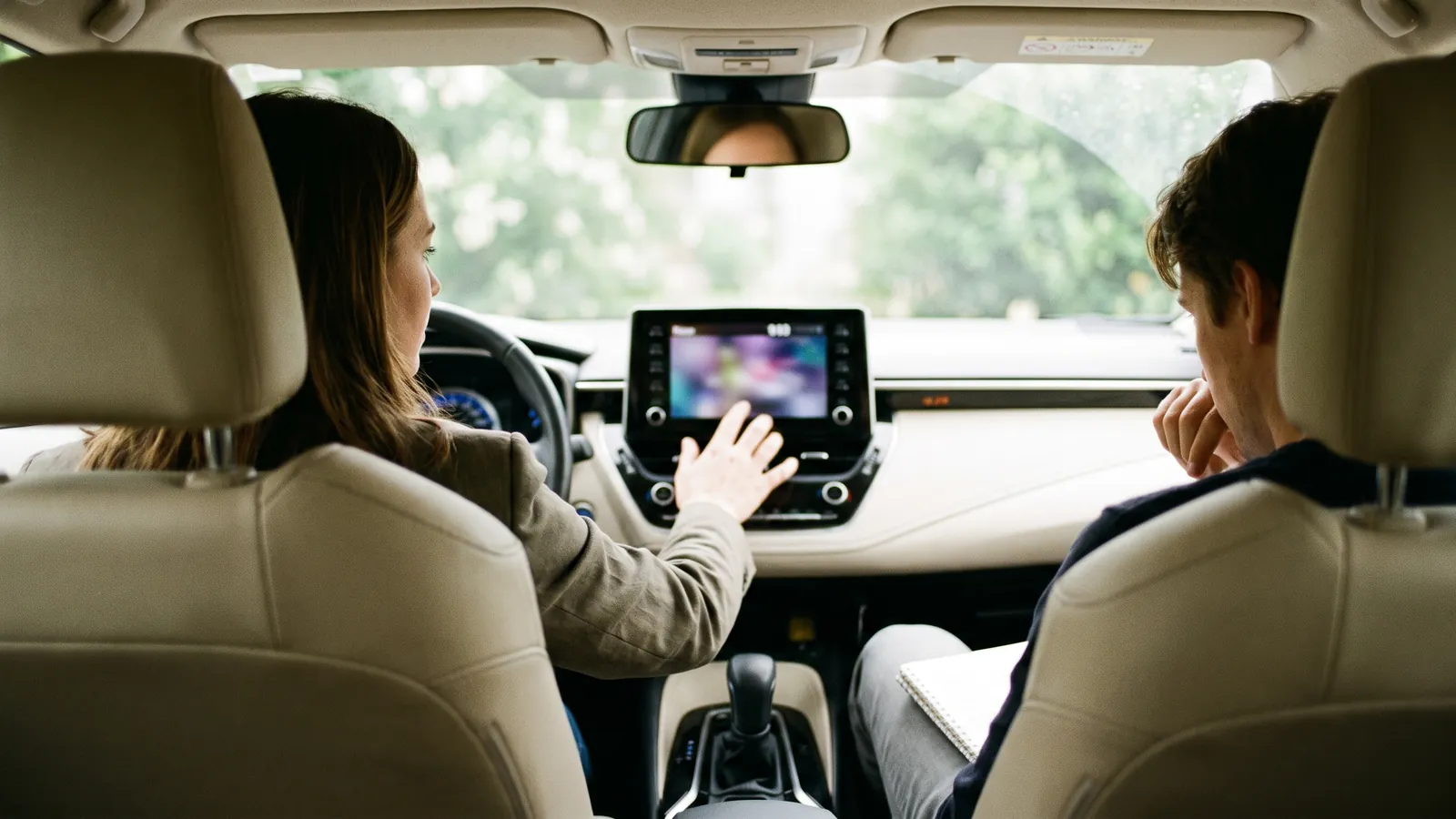
Yes, and the right time is before the software freezes, with drivers who have never seen the screen. A European carmaker brought us a pre-launch infotainment system and one question: where do real drivers get lost? We recruited 48 drivers in Germany, the United Kingdom and the United States, owners of the segment, none of them employees, dealers or journalists.
Each session lasted 60 minutes: 14 tasks in a stationary car (pairing a phone, setting navigation to an address, changing the climate while a passenger talks, answering a call by voice), then a 20-minute drive on a fixed loop with a moderator beside the driver. We measured task completion, time on task and glances away from the road, and we recorded what people said while they struggled.
Eleven issues reached the engineering backlog before launch. The voice flow was rewritten, two menus were flattened and the charging screen moved one tap closer to the home screen. The same method covers apps, voice assistants and head-up displays; our UX research page describes the lab and in-context versions.
How does a car clinic work, and what does it change?
A car clinic puts your vehicle next to its competitors, unbadged, in front of people who intend to buy in the segment, and records what they notice first. A compact SUV facelift, eight months before production, gave us the question in its sharpest form: does the new face earn its price?
The clinic ran over four days in Munich and Madrid with 120 people who intended to buy in the segment within twelve months, recruited on their current car and their budget. Each person walked around the facelift and three competitor vehicles in rotating order: exterior, interior, boot, then a 45-minute individual interview and a 90-minute group with eight others.
The carmaker learnt that the new grille read as "sportier" in Germany and "aggressive" in Spain, that the rear-seat materials cost the car its price premium, and that the boot sill height was the first thing families mentioned. Two interior materials were upgraded, and the launch communication led with practicality in Spain. Clinics can be static or dynamic, with drives on a closed circuit; the format follows how far the car is from production.
How do people buy an electric car from a brand they do not know?
People buy an electric car from a brand they do not know on three things: the test drive, the lease terms and where the showroom is. Which one decides changes by country, and in the three markets we studied the brand name mattered less than any of them. An electric car brand preparing its entry into Spain, Italy and the Netherlands wanted the buyer's journey before it chose where to sell.
The study combined 36 in-depth interviews with recent EV buyers and near-term intenders, twelve accompanied test drives and a two-week mobile diary on charging. In Italy, the test drive was the decision; in the Netherlands, the lease company was. Charging anxiety arrived in the first month of ownership; at the moment of purchase it hardly came up. Nobody had heard the brand's name, and that mattered less than the showroom being in a retail park they already visited.
The brand placed its first points of sale in retail parks, rewrote its test-drive script and built its launch content around the first thirty days of charging. When the decision is where and how to enter a market, this work can sit inside a Customer-Led Strategy programme.
Can you mystery shop our dealerships?
Yes: dealership mystery shopping sends real intenders, briefed, into your showrooms and records what happens when head office is not in the room. A walk-in with a budget and no appointment is the truest test of a dealer network, and a premium brand asked how its dealers greeted exactly that customer.
Sixty real intenders, recruited for the brand's segment in France, Germany, Italy, Poland and the United Kingdom, visited 40 dealerships twice over six weeks with one checklist: wait time before a greeting, whether a test drive was offered, whether anyone asked about the current car, and whether a follow-up arrived within 48 hours. Each visit came back with scores, a narrative and the follow-up email or its absence.
A test drive was offered in fewer than half of the visits, and follow-up varied more between dealers in one city than between countries. The brand rewrote its handover protocol and tied the test-drive offer to the dealer scorecard.
Dealership visits of this kind are mystery shopping the MindMarket way: real consumers from your target audience, briefed in detail, sent in with a checklist, a list of questions and the photos to take, never professional evaluators. The method works for service appointments and online enquiries as well as showrooms, and the mystery shopping page explains how we run it in 60+ countries.
Read how we ran mystery shopping for Kate Spade:

Which connected services will owners pay for every month?
Owners pay for a connected service when it beats the phone in their pocket, and resent paying for one the car should include. A carmaker about to bundle eight connected services into a monthly subscription asked us to find the line before it set the price.
The study ran 24 in-depth interviews and four online focus groups with owners of connected cars in the United States, the United Kingdom and Germany, people who already paid for at least one service in their car or on their phone. Two services were worth paying for in every market: remote pre-heating and live traffic that beat the phone. Two others were read as features the car should include for free, and asking money for them damaged the brand more than it earned.
The bundle shrank from eight services to five, two became free, and the pricing page was rewritten in the owners' words. Pricing questions of this kind pair well with a short quantitative check once the qualitative work has found the candidates.
What do owners do in the first thirty days?
The habits an owner forms in the first thirty days tend to last the length of the lease, and most of that month happens out of the carmaker's sight. Thirty people who had just taken delivery of a new electric car in Norway, Germany and the United Kingdom kept a mobile diary for thirty days: a short entry each evening, a photo when something surprised them, a voice note when something failed. We visited ten of them at home in week four.
The app had been set up by the dealer in a third of the cases and never opened again. Scheduled charging was abandoned after one failed attempt. The feature people loved most, pre-conditioning the cabin, was discovered by chance by half of them.
The carmaker rebuilt its handover checklist, moved three features into a first-week guided tour and changed the order of its onboarding emails. The diary and the home visits are ethnographic research in its lightest form: the car and the driveway are the field.
Which method answers which automotive question
The method follows the question, and most automotive programmes combine two. The table gives the usual pairing, the number of people a study of that kind typically needs, and how long fieldwork takes once recruitment is done.
| Question | Method | People | Fieldwork |
|---|---|---|---|
| Does the screen work? | In-car or lab usability test | 8 to 16 drivers per country | 1 to 2 weeks |
| Does the model hold up? | Static or dynamic car clinic | 80 to 150 intenders per clinic | 3 to 5 days per city |
| How do people buy here? | In-depth interviews, accompanied test drives, diaries | 10 to 15 interviews per country | 2 to 3 weeks |
| What happens in the dealership? | Mystery shopping with real intenders | 1 to 2 visits per dealership | 4 to 6 weeks |
| What would owners pay for? | Interviews and online focus groups | 8 interviews and 1 to 2 groups per country | 2 weeks |
| What do owners do in month one? | Mobile diary and home visits | 10 owners per country | 30 days |
Treat these numbers as starting points. A clinic for a niche segment runs on fewer people; a usability test that has to cover three screen sizes runs on more.
Which study fits your situation
🚗 You are a carmaker with a design freeze in six months. A static clinic in two cities, 80 to 150 intenders, with the competitor set you fear most.
🔧 You are a supplier with a new screen, seat or lighting module. An in-car usability test, 8 to 16 drivers per country, recruited on the models that will carry it.
⚡ You are an electric brand entering Europe. Buyer-journey interviews and accompanied test drives in the countries on your shortlist, before you sign a showroom lease.
🏬 You run a dealer network. Mystery shopping with real intenders, two visits per site, one checklist across countries.
🤝 You are an agency or a consultancy that needs fieldwork in several countries. Recruitment, venues, moderators and evidence under one project lead, with your discussion guide or ours.
Where we run automotive research
MindMarket runs automotive studies in 60+ countries, with field teams and moderators in the markets where most cars are designed, built and bought. The automotive heartlands come with their own habits, and a study that ignores them reads a market wrong.
| Market | What shapes the driver | What we run there |
|---|---|---|
| Germany | Engineering literacy, premium expectations, a fast-moving electric segment | Clinics, in-car usability tests, owner interviews |
| United States | Trucks and SUVs, long distances, dealer-led buying, state by state | Clinics in two or three regions, dealership visits, charging diaries |
| United Kingdom | Leasing and company cars, dense cities, early adoption of connected services | Buyer interviews, subscription research, dealership visits |
| South Korea | Tech-forward early adopters, domestic brands with global reach | Usability tests on screens and apps, owner communities |
| China | The largest electric market, app-first ownership, new brands every quarter | Usability tests, buyer interviews, in-store observation |
| Spain, Italy, France | Price-sensitive buyers, strong dealer relationships, growing electric curiosity | Clinics, market-entry interviews, dealership visits |
Beyond these, we have run automotive and mobility work across Scandinavia, Poland, the Gulf, India, Japan, Mexico and Brazil, with the same team holding the brief. Ask about a country on your list and we will tell you what we can run there and what the local recording rules allow.
Your automotive study, step by step
An automotive study at MindMarket moves through seven steps, from the first call to the debrief, and the first three decide whether the rest is worth doing.
Brief and decision. A call to understand the decision the study has to inform: a design freeze, a launch, a pricing call, a dealer standard. Scope, countries and dates follow from it.
Design. The method, the screener, the tasks or discussion guide, the evidence plan and the recording rules per country, written by one team and reviewed with you.
Recruitment. Drivers screened on what they own, what they will buy and when, from our community and partner networks, replaced when the answers do not hold.
Briefing. Moderators trained on the car, the screen or the brief; drivers told what they need to know and nothing that would turn them into testers.
Fieldwork. Clinics, in-car sessions, interviews, visits or diaries. One project lead, named in the proposal, is your single contact and speaks to every market every day; you coordinate nobody else.
Analysis. Numbers quality-checked so that a score in one market sits beside a score in another; stories and videos coded against the questions you asked.
Debrief. One report for the engineer, the product manager and the marketing director, with what to fix first, and a session to argue it through.

What you receive
Every automotive study delivers three things: the evidence, the comparison across markets, and a recommendation that says what to fix first. The evidence is the task videos, the glance counts, the clinic ratings, the showroom photos, the diary entries and the quotes, organised so an engineer can find the one that concerns her screen.
The comparison is the dataset, quality-checked so that Munich sits beside Madrid and wave two sits beside wave one. The recommendation is a short section at the front of the report that says what to fix first and why, in words the three people who commissioned the study can all agree to.
The report is planned within two weeks of the last session for a single country and within three for several; the proposal states the date, and a debrief call is included. Raw videos and transcripts stay yours. Consent forms, recording permissions and data storage follow the law of each country and your own data policy, and you see both before fieldwork.
What automotive research costs
Automotive studies at MindMarket are quoted on brief, and the quote arrives within 48 hours of the call. Our pricing page lists the methods we run à la carte; a First Listen programme starts from $20,000 per market and a Deep Listen programme from $60,000, with the Study Cost Estimator giving an indicative range for a multi-market design.
Three things move the number more than anything else: the vehicles (a clinic needs cars, a venue and security; a usability test needs the car or a rig), the countries, and the recruitment difficulty of the drivers. A usability test with twelve owners in one country and a clinic with 120 intenders in two cities are different orders of magnitude, and we say so on the first call.
The mistakes that sink automotive studies
Automotive studies fail in predictable ways, and five of them account for most of the damage. Drivers recruited from a standing panel, who have seen four clinics this year and talk like reviewers. A screener that asks what people would like to buy instead of what they will buy, with what money, when. A moderator who cannot tell a hybrid from a plug-in, so the driver stops explaining.
Then two that happen after fieldwork. Scores compared across countries without one team having written both guides, so a German four and a Spanish four mean different things. And a report written for the research team rather than for the engineer, the product manager and the marketing director who have to agree on Monday.
How automotive research feeds the rest of a programme
A single automotive study answers one question, and most carmakers have a calendar of them. That calendar links the studies: the usability test you run before launch sets up the ownership diary you run after it, the dealership visits check how the material the clinic chose is presented on the showroom floor, and the market-entry interviews become the owner diaries once the first cars are delivered.
MindMarket runs each of these as part of a longer conversation with the same team, so the screener from the clinic is reused for the diary and the dealer findings feed the next training wave. For the broader methods, see mystery shopping, UX research, in-depth interviews, online diaries, ethnographic research and central location testing, or the full list of services.
Why choose MindMarket for automotive research?
Carmakers call MindMarket when they need 48 owners in three countries in front of a screen that does not exist yet, and one person who knows all three markets. We recruit the drivers for your brief, one team writes every guide and codes every finding, and the report is written for the engineer, the product manager and the marketing director who have to agree on Monday.
MindMarket field teams in 60+ countries have run clinics in exhibition halls and in-car sessions in rented car parks, dealership visits in five languages and charging diaries through a Norwegian winter. One project lead holds the brief from the first call to the debrief, and the people who wrote the screener are the people who code the findings.
Interested in taking part in automotive studies?
Drivers for every study come from Platicadero, our participant community, and from partner networks. If you drive, intend to buy or lease, and would like to be considered for future clinics, usability tests or diaries in your city, registration takes a couple of minutes.
Frequently asked questions about automotive market research
What do you need from us for a car clinic?
For a car clinic we need your vehicle, the competitor set you want it judged against, and the dates. We find the venue, the security, the rotation plan, the intenders and the moderators, and we can source competitor vehicles through rental and dealer partners when you cannot. Allow six to eight weeks from brief to the first day on site, most of it recruitment and logistics.
How many drivers does a usability test need?
A usability test needs eight to sixteen drivers per country to find the issues that matter, because most usability problems appear within the first eight sessions and the rest confirm them. Three countries at twelve drivers each, as in the infotainment study on this page, is a common design. Larger numbers serve comparison between screen sizes or driver groups rather than discovery.
Can you recruit electric-car intenders in several countries?
Yes, MindMarket recruits electric-car owners and intenders in several countries at once, from its own participant community and partner networks in 60+ countries, screened on their current car, their purchase window and their charging situation at home. Recruitment for a three-country study of twelve to fifteen people per market usually takes two to three weeks. The screener is shared with you before fieldwork, and anyone whose answers do not hold is replaced.
What does an automotive study cost?
An automotive study is quoted on brief within 48 hours of the first call. As a guide, a First Listen programme starts from $20,000 per market and a Deep Listen programme from $60,000; the pricing page lists the methods à la carte. The cost drivers are the vehicles and venues, the number of countries and how hard the drivers are to find. A twelve-driver usability test in one country and a 120-person clinic in two cities sit at opposite ends of the range, and we say which end on the first call.
How long does an automotive study take?
An automotive study takes four to eight weeks from brief to debrief in most cases. Recruitment takes two to three weeks, fieldwork one to two weeks for usability tests and interviews or a few days per city for a clinic, and analysis and reporting two to three weeks. Diaries add their own thirty days. A launch date fixes the end; we work the plan back from it.
Do you run static and dynamic clinics?
Yes, MindMarket runs both static and dynamic clinics. A static clinic examines parked vehicles, exterior, interior and boot, and suits early design decisions. A dynamic clinic adds drives on a closed circuit or an agreed route and suits ride, handling and real-use questions closer to production. Both need vehicles, a secure venue, a rotation plan and moderators who know the segment; we organise all four.
Can you test in-car screens on the road?
Yes, in-car screens can be tested on the road where the law allows, with a moderator in the car. Tasks that need the vehicle moving, such as voice commands at speed or navigation re-routing, run on a fixed loop with a trained driver or the participant at the wheel, depending on the country and the insurance. Tasks that do not need motion run in a stationary car or a rig. Recording rules differ by country; the evidence plan states what is captured where.
Which countries do you cover for automotive research?
MindMarket runs automotive research in 60+ countries, with the deepest automotive experience in Germany, the United States, the United Kingdom, South Korea, China, Spain, Italy and France, and work across Scandinavia, Poland, the Gulf, India, Japan, Mexico and Brazil. One team designs the study and local moderators run it in the driver's language.
Do you work with suppliers as well as carmakers?
Yes, MindMarket works with suppliers as well as carmakers: infotainment, seating, lighting and tyre suppliers bring us the same questions, usually about a component people never think about until it fails. The method is the same; the recruitment is often narrower, because the supplier needs drivers of specific models.
Can automotive research be qualitative and quantitative together?
Yes, automotive research can be qualitative and quantitative together, and the best programmes are. Usability tests and clinics produce structured scores alongside the drivers' words; a subscription study finds the candidate services qualitatively and prices them with a short survey afterwards. The order matters: the qualitative work finds what to measure, and the quantitative work measures it.
Do you run automotive fieldwork for other agencies?
Yes, MindMarket runs automotive fieldwork for research agencies and consultancies that need countries they do not cover: recruitment, venues, moderators and evidence under one project lead, with your discussion guide or ours. Your client relationship stays yours; we appear in the room only if you want us there.
How do you keep a pre-production car confidential?
Confidentiality is built into the study design: a secure venue, non-disclosure agreements signed by participants and staff, no phones in the clinic hall, unbadged vehicles where the brand must not be read, and evidence stored on systems you approve. Participants are told what they may and may not discuss, and the moderator checks that nobody photographs the car.
The short version
Automotive research works when the drivers are real owners and intenders, the moderator knows the car, one team holds every market and the report serves the people who act. The six studies on this page answer the six questions automotive teams bring us most: the screen, the model, the buyer, the dealership, the subscription and the first thirty days.
A car is judged in ninety seconds by someone who has never seen it. Automotive research is how you find out what they judge.
Planning a study? Tell us the decision it has to inform, the markets on your list and the date you cannot move. We will tell you what the study should cover, and what it would take.
What would this cost? Estimate it in 30 seconds.
Rather talk first? Book a call.
